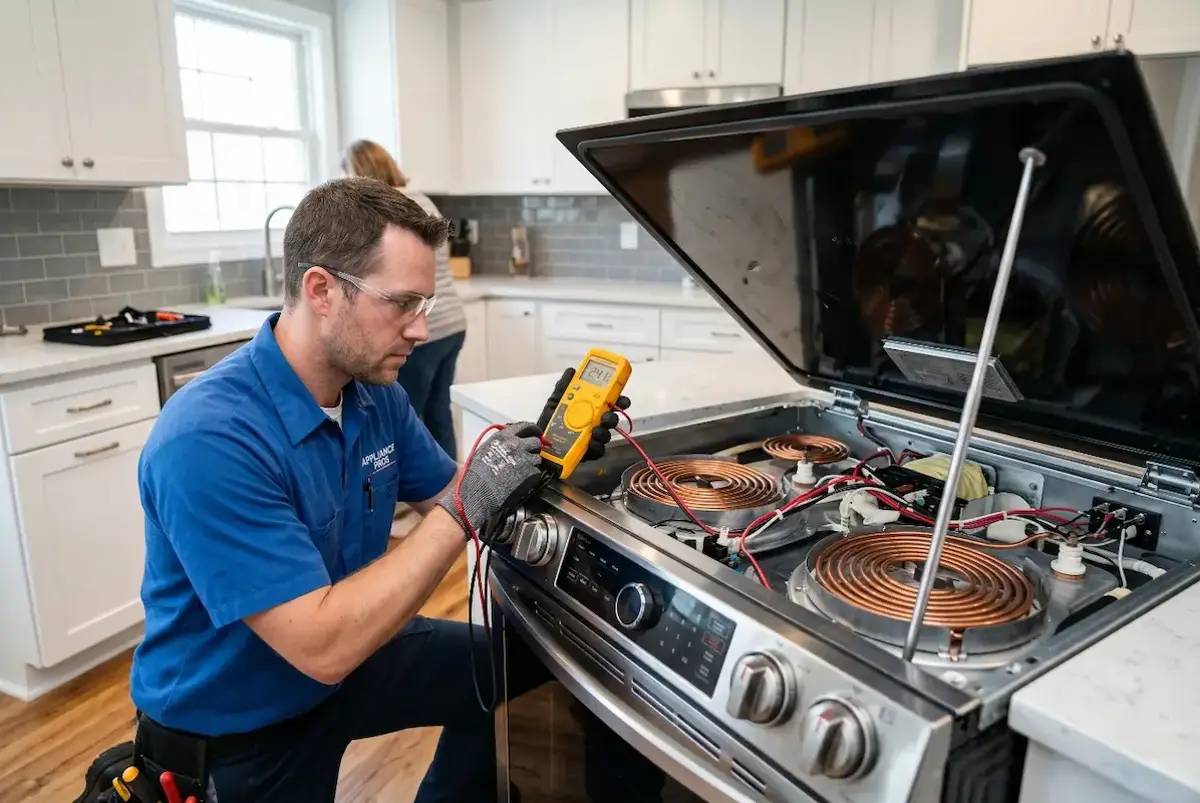
Why does my gas burner click but not light?
Most common cause on a GE stove in Toronto: food debris or spilled liquid clogging the burner ports or the igniter gap (gas-only). A typical repair runs $229–$379 all-in, including the $149.95 diagnostic, credited 100% toward your repair. You can cook on the other burners; book promptly, and treat any lingering gas smell as urgent. Book at convenience
Prices in CAD for Toronto; typical ranges — your exact quote is confirmed on-site before any work. Updated .
Most GE stove faults in Toronto come down to a handful of parts — and the majority are worth repairing rather than replacing an appliance that typically lasts 13–15 years. Anthony is a Red Seal certified technician who carries the common stove parts on the van, so most jobs in Toronto are diagnosed and fixed in a single visit.
How your repair works
Four simple steps, no surprises.
Book
Call or request a callback. Same-day & next-day appointments available.
Diagnose
A flat $149.95 diagnostic pinpoints the real fault.
Approve
You get an upfront all-in quote first — diagnostic credited 100% toward your repair.
Repaired
Fixed with OEM parts, backed by a 90-day warranty.
GE stove gas burner clicks but won't light in Toronto — what we check
- A single surface burner that sparks but never catches is, before any part, a burner-cap, port and electrode-seat problem on GE/Hotpoint/Profile sealed-burner ranges. GE's own surface-ignition guidance (support content #17827) points to a cluster of non-electrical causes for a burner that clicks without lighting -- a dirty or wet burner head, moisture in the ignition/flame ports, an electrode not seated flush, and a burner head and cap not matched up correctly -- and GE notes the burner "will continuously click and will not ignite until the ports are clear and the burner dries out," and that it can take up to 10 or 12 clicks to light. We clear the ports with a fine probe, dry the head (GE suggests a warm oven for ~30 minutes), and reseat the cap flat on its matched head BEFORE condemning any electrical part, because this $0 check clears a large share of single-burner no-light calls.
- Clicks and a visible spark but no flame on one burner points to that position's spark electrode -- on GE the electrodes-and-harness assembly WB18K10098 (AP5790579; supersedes WB18K10058 / 3025630 / PS8754234) carries the high-voltage electrodes to the burners; the individual burner igniter/electrode WB02X10822 (AP3416919 / PS224072; assembly with spring and clip; supersedes WB02X11363 / WB02X10794 / WB02X10780 / WB02X11267) cracks at the white ceramic insulator from spillover and thermal shock so the spark jumps to the burner base instead of the cap gap and the gas never lights. We compare to the neighbouring burners: if the siblings light clean and only one keeps ticking without catching, the cracked electrode for that position is the failed part, not the shared module.
- One burner that won't even start clicking when its knob is turned while the others spark normally isolates to that position's spark ignition switch, GE WB24X10091 (AP3186866; the 12 o'clock single switch that supersedes WB24X10089 / 946599 / PS651383, replaced per burner position), or the ganged 4-burner switch-and-harness WB24X10143 (AP4264976 / PS1019312) on harness-design ranges. The switch mounts on the burner valve stem and closes to feed the spark module when the knob is pushed and turned; a pitted or stuck-open contact means that position never signals the module, so there is no click and no spark on that one burner. We meter each switch for continuity at the lit position before ordering, so a dead-burner-only call isn't mis-quoted as an electrode or module job.
- All burners clicking together but none lighting, or no spark anywhere, is the surface-burner spark module signature -- GE WB13K10029 (AP4363383; replaces 1473628 / AH2339789 / EA2339789 / PS2339789 / 223C4955P002) on many GE gas ranges, or the WB13T10076 module (AP3993727 / PS1480954; supersedes WB13X10011 / WB13X10012) on the GE/Hotpoint/RCA platform. One module pulses high-voltage to every surface electrode at once; a failed module gives a weak, intermittent, or no spark to all positions so none light. Because module failure is the one fault that hits the whole cooktop together rather than a single burner, we condemn it LAST -- only after the caps, electrodes (WB18K10098 / WB02X10822) and switches (WB24X10091) all check out -- since on this platform a whole-top no-light is more often moisture or a switch than a dead module.
- A burner that sparks cleanly but lights weak, lazy, or yellow and is hard to ignite, with a healthy electrode and module, is usually a gas-type/orifice or pressure mismatch, not an ignition part. A GE range left on its factory natural-gas orifices after an LP swap (or the reverse) barely catches even when the electrode sparks correctly; GE ships the LP conversion kit WB28K10593 (now ordered through the superseding WB28K10567 family) or the actively-stocked WB28K10556 (AP4368229) of orifice spuds plus the regulator/pressure-regulator parts for exactly this. Wrong orifice size or an unconverted regulator is a TSSA-certified gas-fitter correction (orifice/regulator/pressure), not a parts swap, and we verify it before condemning any electrode or module.
- A 'won't light' complaint that is actually the OVEN, not the cooktop, traces to the gas oven glow-bar igniter, GE WB13K21 (AP2020569; flat/round bake igniter shared across GE / Hotpoint / Kenmore gas ovens). On a glow-bar system the igniter must draw enough current through the oven safety valve's bimetal to pull the valve open; when it glows orange for more than ~90 seconds without the oven lighting it has weakened and can no longer open the valve. The real pass/fail is current draw, not the glow: a healthy GE glow-bar igniter draws roughly 3.2-3.6 A, and at or below ~2.9 A it is weak and should be replaced even if it still glows. Cold resistance (~40-200 ohms across GE models) is only a secondary sanity check, because a failing igniter often reads near-normal ohms yet still draws too little current to open the valve.
- A gas oven that won't light with a confirmed-good igniter -- the igniter glows strong and draws normal current (~3.2-3.6 A) but no flame appears -- points to the oven safety valve, GE WB19K13 (genuine OEM, PS233872, 3/8" inlet; fits GE / Hotpoint / Haier / Monogram / Café gas ovens). The valve is a fail-safe that only opens to release gas to the bake/broil burner once the igniter heats its bimetal enough; a failed valve stays shut whether or not the igniter is healthy, so no gas means no flame. We replace the WB19K13 only after the igniter (WB13K21) tests good on current draw, so an owner isn't sold a valve when a weak igniter is the real fault.
GE gas burner clicks but won't light in Toronto — the local specifics
- The recurring GE-in-Toronto pattern on this fault is the post-cleaning single-burner no-light: a boil-over or a wet wipe-down soaks the burner head and ports or the under-knob spark switch, and the burner clicks endlessly without catching -- GE's own guidance that a burner 'will continuously click and will not ignite until the ports are clear and the burner dries out' describes exactly what we find. The honest split is cap/port/moisture and a cracked WB02X10822-style electrode on single-burner calls, versus the WB13K10029/WB13T10076 module on the rarer all-burners-dead calls; when the complaint is really the oven not lighting, it lands on a weakened WB13K21 glow-bar igniter far more often than the WB19K13 safety valve.
- We carry to these calls the GE surface spark module (WB13K10029 and the WB13T10076 variant), the 12 o'clock spark ignition switch WB24X10091 plus the WB24X10143 switch-and-harness for the ganged-design ranges, the electrodes-and-harness assembly WB18K10098 and the single burner electrode WB02X10822, and on the oven side the WB13K21 glow-bar igniter and the WB19K13 oven safety valve -- so a moisture/port dry-out, a single dead burner, an all-burners no-spark, or an oven that won't light can each be closed on the first TSSA-certified visit.
For the full GE stove module — every fault, part number and code — see GE stove repair in Toronto, and for the same fault across all brands the stove gas burner clicks but won't light guide.
Ready to get it fixed?
Call now — (647) 490-7878 90-day warranty · flat $149.95 diagnostic credited 100% toward your repairWhy homeowners across Toronto call us
Every repair is led by Anthony, a Red Seal interprovincial journeyman who is 313A Licensed, TSSA Certified, ODP Certified, with his team working under his direct leadership — backed by $2,000,000+ general liability insurance and a 90-day workmanship warranty on every job.
Red Seal-led team
Every job is overseen by Anthony, a certified journeyman, and handled by his own trusted team.
Licensed & gas-certified
313A refrigeration licence and TSSA gas certification for safe, code-correct repairs.
$2,000,000+ insured
Fully insured for general liability, so your home is protected during the repair.
90-day warranty
Parts and workmanship are warrantied — if it's not right, we come back.
OEM parts on the van
Common parts are stocked, so most jobs are completed on the first visit.
Upfront pricing
A flat $149.95 diagnostic, credited 100% toward your repair, and a quote before any work.
What our credentials mean for you
- Red Seal Certified
- The interprovincial standard for skilled trades — a journeyman who passed the national appliance-service exam.
- 313A Licensed
- Ontario's refrigeration & air-conditioning systems mechanic licence — legally required to work on sealed cooling systems.
- TSSA Certified
- Technical Standards & Safety Authority gas certification — qualified to work safely on gas appliances.
- ODP Certified
- Ozone Depletion Prevention certification — licensed to handle refrigerants responsibly and to code.
More appliance repair in Toronto
Brands we service
Other appliances
Nearby cities
Frequently asked questions
How fast can you repair my Stove in Toronto?
Do you charge for the diagnostic?
How soon can you come out?
Are you licensed and insured?
Do you use genuine parts?
Do you service GE stoves?
Need your GE stove fixed in Toronto?
Same-day & next-day appointments available. Flat $149.95 diagnostic, credited 100% toward your repair, and a 90-day warranty on every repair.
Call (647) 490-7878