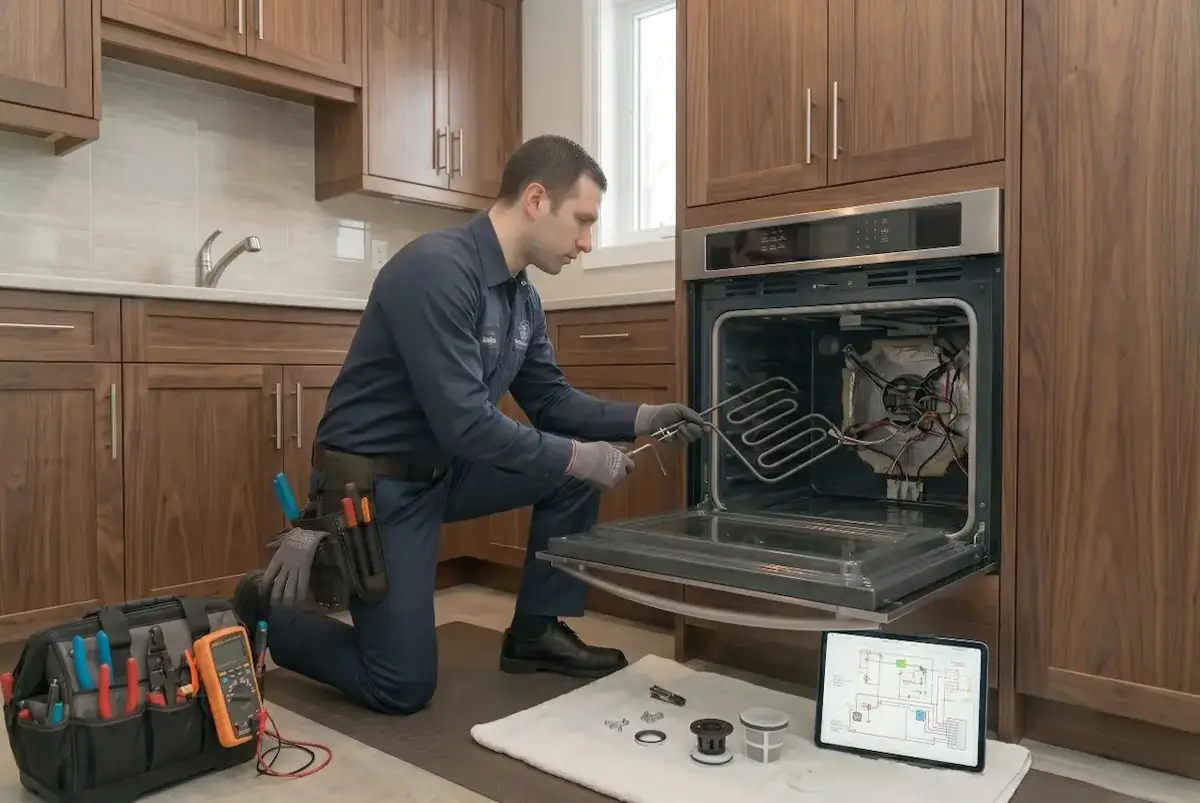
Why is my oven temperature wrong / inaccurate?
Most common cause on a KitchenAid wall oven in Toronto: drifted oven temperature sensor (RTD/thermistor) — resistance has shifted out of spec. A typical repair runs $319–$449 all-in, including the $149.95 diagnostic, credited 100% toward your repair. A quality/usability issue — book at your convenience. Book at convenience
Prices in CAD for Toronto; typical ranges — your exact quote is confirmed on-site before any work. Updated .
Most KitchenAid wall oven faults in Toronto come down to a handful of parts — and the majority are worth repairing rather than replacing an appliance that typically lasts 13–15 years. Anthony is a Red Seal certified technician who carries the common wall oven parts on the van, so most jobs in Toronto are diagnosed and fixed in a single visit.
How your repair works
Four simple steps, no surprises.
Book
Call or request a callback. Same-day & next-day appointments available.
Diagnose
A flat $149.95 diagnostic pinpoints the real fault.
Approve
You get an upfront all-in quote first — diagnostic credited 100% toward your repair.
Repaired
Fixed with OEM parts, backed by a 90-day warranty.
KitchenAid wall oven oven temperature inaccurate in Toronto — what we check
- RTD sensor drift is the leading temp-inaccurate cause on KitchenAid Even-Heat columns, and the direction of the error matters. The board reads the aluminum RTD probe (WPW10131825 / AP6015486 / PS11748765), which reads roughly 1080-1090 ohms at room temperature and climbs with heat to about 1654 ohms at 350F (add ~2 ohms per degree above 70F). When the probe drifts high or reads open, the board thinks the cavity is hotter than it is and cuts heat early, so the oven runs cold and undershoots setpoint. We ohm the probe cold against that ~1080-1090 ohm baseline and replace the sensor first; the board only if a known-good probe still reports wrong temps.
- A sensor whose tip has slipped so it touches the cavity wall or a rack reads falsely high and makes the oven run cold without ever setting a code, which is a real KitchenAid pattern, not a board fault. The wall radiates hotter than the air, so the probe reports a temperature the cavity has not reached and the board stops driving the elements. The fix is to reposition the probe so it sits proud off the back wall on its two mounting screws before condemning anything; a repositioned sensor is the cheapest honest fix and saves the WPW10131825 entirely.
- On the newer KitchenAid wall-oven UI, the temp-inaccurate sensor faults are the F3 family: F3 E0 flags the upper oven temperature sensor, control, or associated wiring, and F3 E1 flags the lower oven temperature sensor, control, or wiring, so on a double-oven column the code tells you which cavity to chase. F3 E2 is the generic oven temperature sensor / control / wiring fault (KitchenAid's pages do not split these into open-vs-shorted; that read comes from metering, not the code text). All of them point at sensor WPW10131825 first: meter it against ~1080-1090 ohms at room temperature, and if a new probe still codes, move to the harness between the sensor and the Oven Appliance Manager, then the board, rather than a parts-cannon to the control. On the older Whirlpool range tech-sheet scheme the same F3 numbers mean different things (F3E0 = sensor open, F3E1 = sensor shorted, F3E2 = over-temperature), so we confirm the platform before reading a code.
- An oven that runs hot and overshoots setpoint is the opposite failure, and on these columns the usual cause is a welded or sticking bake relay on the oven control board with power supply (W11179310, the Oven Appliance Manager). A relay whose contacts have fused from arcing feeds the bake element continuous power regardless of what the sensor reports, so the cavity climbs past setpoint and can keep heating. We prove this on the meter by watching AC voltage at the element terminals through a bake cycle: a relay that never opens when the board commands off is a board fault, not a sensor fault, and W11179310 is condemned only after the sensor reads good.
- A weak or partly-open bake element produces a true 'reaches temperature then stalls low' temp-inaccurate call rather than a flat no-heat. The lower bake element (WPW10276482 / AP6018421 / PS11751723, the ~18-inch 240V 3600W element, replaces 74011117) carries the hold while broil and convection assist only the preheat. The tell is an element that does not glow fully red and ohms open or out of range; a customer who says 'it gets warm but never holds the set temperature' usually has a degrading bake element, not a sensor or a board.
- When an oven runs only mildly off, it is often calibration drift, not a failed part, and KitchenAid's own range is the honest reference. The control's temperature offset adjusts between +30F and -30F (in 5F steps on Method 2, 10F steps on Method 3 per KitchenAid's product-help page), so an oven off by more than ~30F cannot be dialed out and the real cause is the RTD sensor (WPW10131825) or the control board (W11179310). KitchenAid also warns that a slow-reacting dial thermometer is not a valid test because the elements cycle and read slightly hot or cool at any instant, so we measure actual-vs-set with a fast probe across a full cycle before touching calibration.
- Convection-mode inaccuracy is a separate heat path: an oven that bakes accurately but won't hold the set temperature on convection points at the convection element or the convection fan motor (W10860984) circuit, not the bake element or the sensor. The fan must move air across its element to hold a true-convection setpoint, so a stalled or noisy convection fan reads as 'convection bakes cold/uneven' while standard bake is fine. We verify the bake and convection circuits independently rather than blaming one element or the RTD for a mode-specific temp complaint.
KitchenAid oven temperature inaccurate in Toronto — the local specifics
- The recurring KitchenAid-in-Toronto temp-inaccurate pattern is a split between two opposite complaints that need opposite parts: older Even-Heat columns that gradually run cold and undershoot (RTD drift or a probe that slipped against the cavity wall) versus units that overshoot and run hot (a sticking or welded bake relay on the control board). We meter the RTD against its ~1080-1090 ohm room-temperature baseline and watch the element-relay behavior before deciding which way the fault runs, because the cold-running and hot-running calls look the same to the customer but point at completely different parts.
- We carry the KitchenAid oven temperature sensor (WPW10131825) and the lower bake element (WPW10276482) to these calls as the stocked first-line parts, along with a fast probe thermometer to confirm actual-vs-set across a full cycle. The W11179310 control board with power supply we confirm by model/serial and order when a stuck-relay overshoot is proven on the meter, since it is the slower-moving part and not worth swapping on suspicion.
For the full KitchenAid wall oven module — every fault, part number and code — see KitchenAid wall oven repair in Toronto, and for the same fault across all brands the wall oven oven temperature inaccurate guide.
Ready to get it fixed?
Call now — (647) 490-7878 90-day warranty · flat $149.95 diagnostic credited 100% toward your repairWhy homeowners across Toronto call us
Every repair is led by Anthony, a Red Seal interprovincial journeyman who is 313A Licensed, TSSA Certified, ODP Certified, with his team working under his direct leadership — backed by $2,000,000+ general liability insurance and a 90-day workmanship warranty on every job.
Red Seal-led team
Every job is overseen by Anthony, a certified journeyman, and handled by his own trusted team.
Licensed & gas-certified
313A refrigeration licence and TSSA gas certification for safe, code-correct repairs.
$2,000,000+ insured
Fully insured for general liability, so your home is protected during the repair.
90-day warranty
Parts and workmanship are warrantied — if it's not right, we come back.
OEM parts on the van
Common parts are stocked, so most jobs are completed on the first visit.
Upfront pricing
A flat $149.95 diagnostic, credited 100% toward your repair, and a quote before any work.
What our credentials mean for you
- Red Seal Certified
- The interprovincial standard for skilled trades — a journeyman who passed the national appliance-service exam.
- 313A Licensed
- Ontario's refrigeration & air-conditioning systems mechanic licence — legally required to work on sealed cooling systems.
- TSSA Certified
- Technical Standards & Safety Authority gas certification — qualified to work safely on gas appliances.
- ODP Certified
- Ozone Depletion Prevention certification — licensed to handle refrigerants responsibly and to code.
More appliance repair in Toronto
Brands we service
Nearby cities
KitchenAid Wall Oven problems in Toronto
Frequently asked questions
How fast can you repair my Wall Oven in Toronto?
Do you charge for the diagnostic?
How soon can you come out?
Are you licensed and insured?
Do you use genuine parts?
Do you service KitchenAid wall ovens?
Need your KitchenAid wall oven fixed in Toronto?
Same-day & next-day appointments available. Flat $149.95 diagnostic, credited 100% toward your repair, and a 90-day warranty on every repair.
Call (647) 490-7878