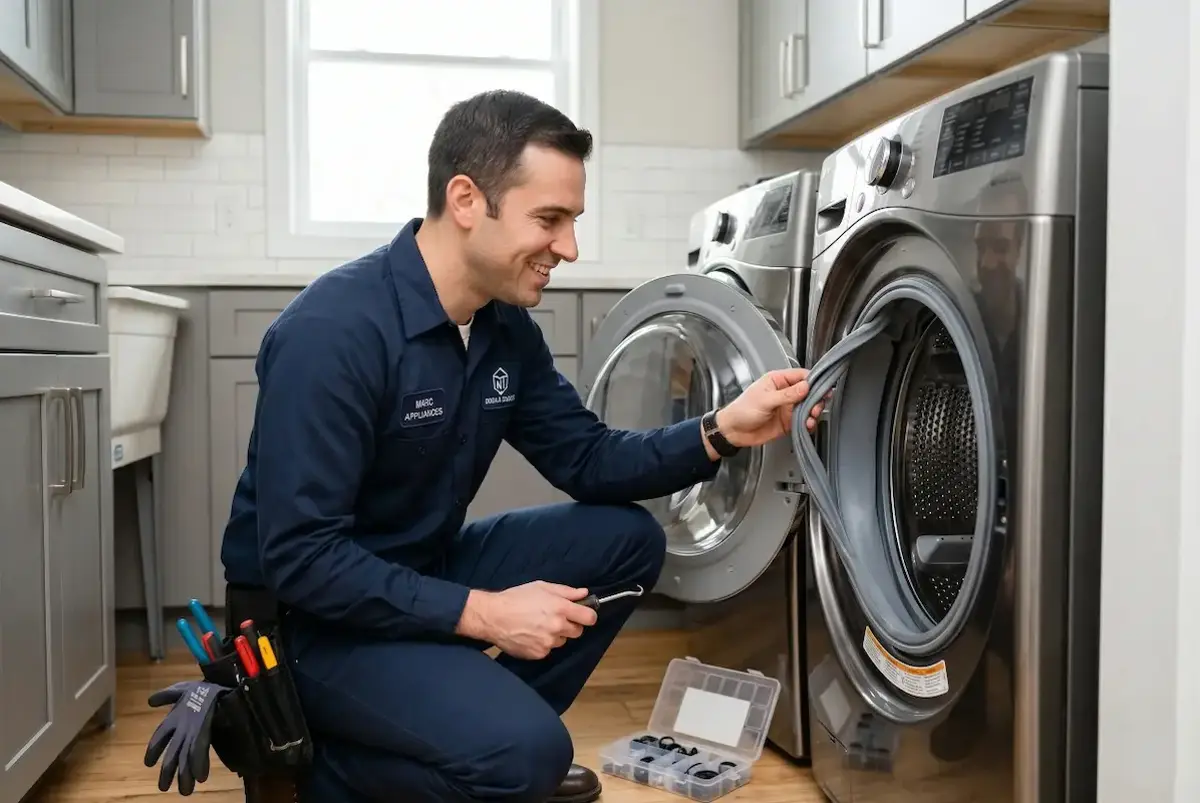
Why does my front-load washer smell musty or mouldy?
Most common cause on a Miele washing machine in Toronto: mould/biofilm growing in the door-gasket folds and dispenser from a door kept shut after washing. A typical repair runs $269–$419 all-in, including the $149.95 diagnostic, credited 100% toward your repair. No safety hazard; book if cleaning doesn't resolve it (often points to a torn gasket or drain issue). Book at convenience
Prices in CAD for Toronto; typical ranges — your exact quote is confirmed on-site before any work. Updated .
Most Miele washing machine faults in Toronto come down to a handful of parts — and the majority are worth repairing rather than replacing an appliance that typically lasts 10–13 years. Anthony is a Red Seal certified technician who carries the common washing machine parts on the van, so most jobs in Toronto are diagnosed and fixed in a single visit.
How your repair works
Four simple steps, no surprises.
Book
Call or request a callback. Same-day & next-day appointments available.
Diagnose
A flat $149.95 diagnostic pinpoints the real fault.
Approve
You get an upfront all-in quote first — diagnostic credited 100% toward your repair.
Repaired
Fixed with OEM parts, backed by a 90-day warranty.
Miele washing machine smells musty or mouldy (front-load) in Toronto — what we check
- The single most common smells-musty source on a Miele front-loader is biofilm in the lower third of the door bellows, and it is the same gasket that fails on leak calls: the Miele washer door seal 6816000 (carried as 6816001, superseding the older 3827625 / 4223910 / 4223911 family, confirmed on Sears PartsDirect, Kenco Spares and Ersatzteilwelt) traps standing water, detergent sludge and hair in its lower fold where it can't air-dry, and that fold breeds the mould that produces the sour, musty odour. Miele's own guidance is to wipe the rubber door seal with a clean dry cloth after each wash; we deep-clean and inspect the fold first, and only quote the 6816000 boot when the rubber is genuinely perished or permanently mould-stained rather than merely dirty, because a wipe-down-and-air-dry is a no-part fix and a torn, blackened bellows is the one that actually gets the seal.
- Low-temperature washing is the root cause Miele documents behind a musty machine: per Miele's own 'eliminate bad odours' guidance, a steady diet of cold and 30-40C eco cycles never gets hot enough to break down the fat/detergent biofilm that lines the drum, sump and dispenser, so bacteria establish and the machine sours. Miele's published remedy is a monthly maintenance wash - the 'Clean Machine' programme (or a Cottons cycle) run empty at 60C or higher, after roughly every 20 cold-water cycles - to thermally clear the biofilm. This is a habit-and-program fix, not a SKU; a Toronto suite that only ever runs cold-economy cycles is the classic recurring musty call with no failed part.
- The detergent dispenser drawer and its siphon are a documented Miele odour reservoir: per Miele's own dispenser-cleaning guidance, water is used to flush powder and liquid product through the drawer into the suds container, and when the siphon cap, the nozzles and the flush channel silt up with detergent and softener residue they grow mould and feed a musty smell every cycle. The published procedure is no-part - pull the drawer to the resistance stop, press the release catch, remove it, and scrub the drawer, siphon and nozzles under warm water with a bottle brush, then clear the rubber hose from the housing down to the tub. We clean the dispenser and its flush channel before condemning anything, because a fouled siphon mimics a deeper drum-odour problem and is owner-maintenance, not a part.
- A silted cleanable trap / fluff (drain) filter holding standing water is a recurring musty source the owner can't see: the Miele bottom-left service-flap filter catches coins, lint and hair, and when it isn't emptied (Miele's guidance is at least twice a year) the residue and trapped water in the pump volute stagnate and smell. The drain pump itself is the Miele DPS25-375, order number 10908780 (220-240V factory part, made by Hanning, superseding the older Hanning 9193610 / 9193611). We open the lower flap, run the emergency drain hose, unscrew and flush the trap and free-spin the impeller to clear the stagnant water before quoting anything, since a stinking sump is almost always a dirty trap, not a failed 10908780.
- When a hard-water Toronto machine smells musty AND the cycles are getting longer or cooler, the documented fix is a descale-and-clean rather than a part: limescale and grease bond detergent residue to the drum and heater where biofilm grows, and Miele sells a specific remedy - Miele IntenseClean machine cleaner/descaler, part 10130990 (which supersedes the older 09043380, confirmed on mieleusa.com appliance-care, Hudson Appliance and B&B Appliance). Miele's instruction is to run it through a hot main wash on an empty drum (repeat if needed). We run an IntenseClean descale cycle on a scaled, smelly Toronto unit before opening the cabinet, because chasing a 'mould' smell with a teardown when the real driver is limescale-bound biofilm is the classic over-repair on this brand.
- On TwinDos-equipped W1 models the auto-dosing lines are a Miele-specific musty reservoir: when the UltraPhase cartridges run empty for months or the machine is run cold, detergent residue gums and ferments inside the dosing lines and feeds an odour that survives a normal drum clean. Miele's documented care for this is to run the 'Clean TwinDos' maintenance flush from the Maintenance menu (which flushes the internal dosing lines and pump that a normal wash never reaches) rather than to replace a part - the cheapest Miele fix here is a flush, not a SKU. We run the TwinDos maintenance flush and check the cartridge state on any musty TwinDos machine before assuming the smell is the drum or boot.
- A musty smell paired with the F138 'water in the drip/floor tray' code is the case where the odour is stagnant water under the tub, not surface mould: per Miele's own F138 guidance the Waterproof flood-protection float has tripped on water pooled in the base tray after a leak upstream, and that trapped water sits and sours. The published recovery (find and stop the leak, then dry the tray) only clears the code, so we treat a re-firing F138 as a mandate to find and stop the upstream source - most often the same weeping door boot 6816000 or a loose trap/sump clamp - and dry the tray, rather than masking the smell with a clean cycle while the leak keeps refilling the tray.
Miele smells musty or mouldy (front-load) in Toronto — the local specifics
- The recurring Toronto pattern is a Miele in a condo or stacked closet install that runs almost entirely cold/eco cycles with the door kept shut between loads: the lower bellows fold and the dispenser siphon never dry, biofilm establishes, and the owner calls it 'mould' when most of these clear with a 60C Clean Machine wash, a dispenser scrub and a bellows clean - no part. The minority that genuinely need the door seal 6816000 are the ones where the rubber is torn or permanently blackened, and the hard-water units are the ones that only break the smell after an IntenseClean descale.
- We arrive with Miele IntenseClean descaler/cleaner 10130990, a bottle brush for the dispenser siphon and nozzles, and the kit to pull and flush the cleanable trap and run the emergency drain - the no-part toolkit that resolves most smells-musty calls. The door boot 6816000 (6816001) and DPS25-375 drain pump 10908780 are ordered by model/serial only after the deep clean confirms a genuinely failed part.
For the full Miele washing machine module — every fault, part number and code — see Miele washing machine repair in Toronto, and for the same fault across all brands the washing machine smells musty or mouldy (front-load) guide.
Ready to get it fixed?
Call now — (647) 490-7878 90-day warranty · flat $149.95 diagnostic credited 100% toward your repairWhy homeowners across Toronto call us
Every repair is led by Anthony, a Red Seal interprovincial journeyman who is 313A Licensed, TSSA Certified, ODP Certified, with his team working under his direct leadership — backed by $2,000,000+ general liability insurance and a 90-day workmanship warranty on every job.
Red Seal-led team
Every job is overseen by Anthony, a certified journeyman, and handled by his own trusted team.
Licensed & gas-certified
313A refrigeration licence and TSSA gas certification for safe, code-correct repairs.
$2,000,000+ insured
Fully insured for general liability, so your home is protected during the repair.
90-day warranty
Parts and workmanship are warrantied — if it's not right, we come back.
OEM parts on the van
Common parts are stocked, so most jobs are completed on the first visit.
Upfront pricing
A flat $149.95 diagnostic, credited 100% toward your repair, and a quote before any work.
What our credentials mean for you
- Red Seal Certified
- The interprovincial standard for skilled trades — a journeyman who passed the national appliance-service exam.
- 313A Licensed
- Ontario's refrigeration & air-conditioning systems mechanic licence — legally required to work on sealed cooling systems.
- TSSA Certified
- Technical Standards & Safety Authority gas certification — qualified to work safely on gas appliances.
- ODP Certified
- Ozone Depletion Prevention certification — licensed to handle refrigerants responsibly and to code.
More appliance repair in Toronto
Brands we service
Nearby cities
Frequently asked questions
How fast can you repair my Washing Machine in Toronto?
Do you charge for the diagnostic?
How soon can you come out?
Are you licensed and insured?
Do you use genuine parts?
Do you service Miele washing machines?
Need your Miele washing machine fixed in Toronto?
Same-day & next-day appointments available. Flat $149.95 diagnostic, credited 100% toward your repair, and a 90-day warranty on every repair.
Call (647) 490-7878