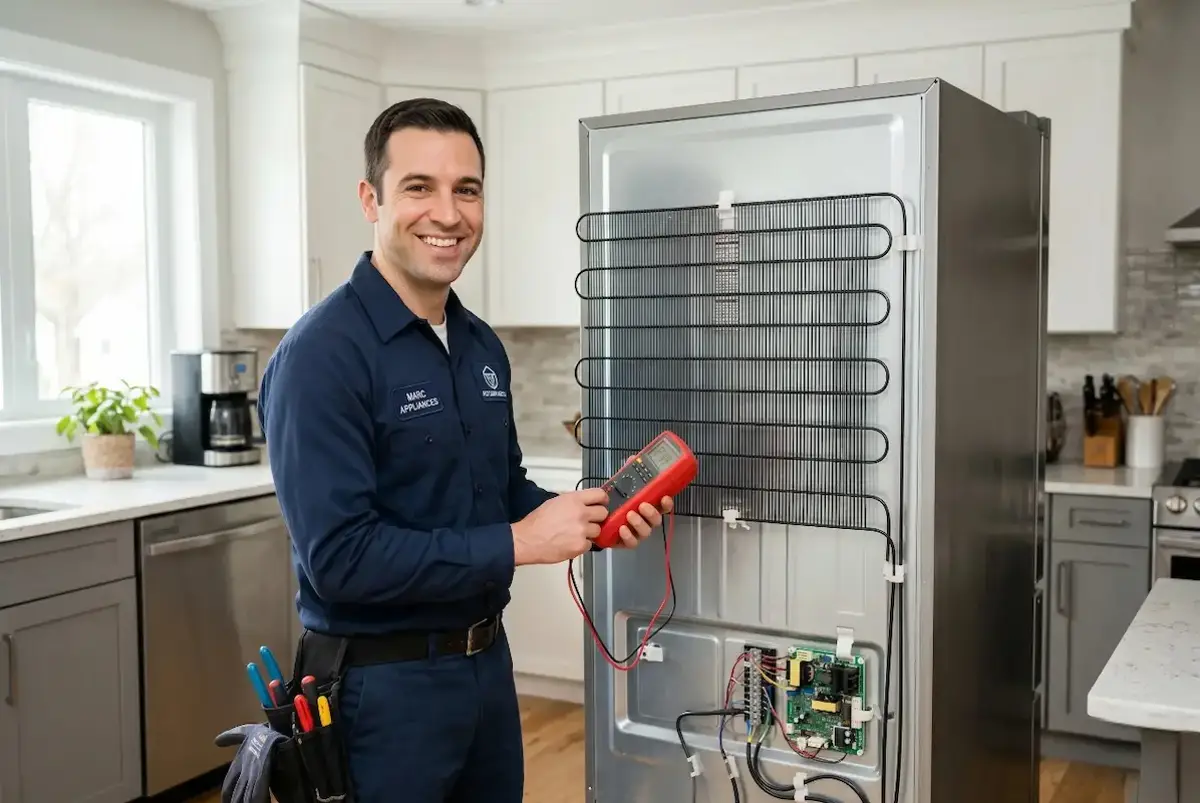
Why is my freezer building up frost?
Most common cause on a KitchenAid refrigerator in Toronto: failed defrost system (defrost heater, thermostat/sensor, or timer/control). A typical repair runs $379–$519 all-in, including the $149.95 diagnostic, credited 100% toward your repair. Not an emergency, but it worsens and eventually blocks airflow. Book at convenience
Prices in CAD for Toronto; typical ranges — your exact quote is confirmed on-site before any work. Updated .
Most KitchenAid refrigerator faults in Toronto come down to a handful of parts — and the majority are worth repairing rather than replacing an appliance that typically lasts 10–15 years. Anthony is a Red Seal certified technician who carries the common refrigerator parts on the van, so most jobs in Toronto are diagnosed and fixed in a single visit.
How your repair works
Four simple steps, no surprises.
Book
Call or request a callback. Same-day & next-day appointments available.
Diagnose
A flat $149.95 diagnostic pinpoints the real fault.
Approve
You get an upfront all-in quote first — diagnostic credited 100% toward your repair.
Repaired
Fixed with OEM parts, backed by a 90-day warranty.
KitchenAid refrigerator frost or ice build-up in Toronto — what we check
- On the freestanding French-door/counter-depth line (KRFF/KRFC, premium-trim Whirlpool platform), the most common frost-buildup root cause is the defrost circuit, and it is two parts that fail the same way. The bimetal defrost thermostat WPW10225581 clips to the evaporator coil and must CLOSE cold so the defrost heater assembly WPW10436849 (PartSelect PS11754723, the genuine Whirlpool element confirmed to fit the KRFF300E series) can fire and melt each cycle's frost. If the bimetal opens or the heater element burns out, auto-defrost never completes, the coil sheets over behind the freezer rear cover, airflow chokes, and the freezer/fridge slowly warm. We continuity-test the thermostat at the coil AND the heater element separately before condemning either, because a dead thermostat and a dead heater both present as 'won't defrost / frosted-over coil.'
- KitchenAid's own diagnostic service mode confirms the defrost verdict before any part is ordered: service test 6 reads the bimetal defrost thermostat status (01 = closed, 02 = open) and service test 38 forces a defrost cycle so we can watch the heater actually energize and clear the coil. We drive test 6 and test 38 from the control panel to separate a failed-open bimetal from a burned-out heater, rather than swapping both — a frosted KitchenAid that fails test 6 is a thermostat, while one that passes test 6 but never clears under test 38 is the WPW10436849 heater.
- Frost that grows over DAYS with a good thermostat and a good heater and no clear failure points at the control board mistiming the adaptive defrost cycle, not at a defrost-circuit part. On the freestanding line the main control runs the adaptive defrost timer (service test 7 reports ADC mode: 01 = adaptive on, 02 = basic 8-hour schedule), so a board that skips or stretches defrost intervals lets the evaporator ice up with NO display code. We prove the heater and thermostat good first (tests 6 and 38), then look at the board — never lead with the most expensive part on a frosted KitchenAid.
- An ice SLAB on the freezer floor (rather than frost on the back coil) is the signature Whirlpool-platform fault on this line and it has a real OEM fix: the original duck-bill defrost drain tube clogs with sludge then freezes solid, so each defrost cycle's meltwater overflows the trough, refreezes in the channel, and dumps the next melt onto the freezer floor under the crisper drawers. The cure is Whirlpool's redesigned P-Trap Drain Tube Kit W10619951 (PartSelect PS8691807 / AP5780744), which deletes the duck-bill grommet entirely — but only after we fully thaw the iced-up drain path with a steamer behind the rear evaporator cover, because installing the new tube over residual ice just reproduces the clog.
- A drifting thermistor feeds the board bad temperature data and makes it run defrost and cooling wrong, a quiet frost-buildup cause on electronic models: KitchenAid surfaces this as an E1 (open thermistor) or E2 (shorted thermistor) fault, and diagnostic service test 1 reports the freezer thermistor as a result code (01 = pass, 02 = open, 03 = shorted) with test 2 doing the same for the fresh-food sensor. The NTC sensor reads roughly 5,000–25,000 ohms across its cold range; we read the test-1 code off the temperature display and ohm the suspect sensor against spec before touching the board, because an open or shorted thermistor mistimes defrost and mimics a frost fault while every defrost part is healthy.
- A stalled or frost-jammed evaporator fan compounds frost-buildup: the freezer evaporator fan motor W11024089 (PartSelect PS11773024, replacing W10199049/W10904013, the correct fan for the KRFC300/KRFF302 freestanding line — NOT the legacy W10189703/WPW10189703 motor, a distinct part) jams against an ice ridge or loses its winding, so cold air stops circulating, the box warms, and migrating moisture refreezes on the back panel and over the defrost drain. Because a frosted-jammed fan and a dead motor present identically, we spin the blade by hand and ring out the windings — and clear the ice — before swapping the motor; service test 3 cycles the evaporator fans and air-baffle motor to confirm.
- Frost that tracks the DOOR perimeter and the front liner rather than the evaporator is a sealing fault, not a defrost fault, and KitchenAid's own product-help literature documents it: a twisted, dirty, or compression-set door gasket, or sagging hinges/door supports that leave a French door not closing flush, lets humid room air pour in, condense on cold interior surfaces, and freeze along the gasket line and rear wall. We rule it in by checking whether the frost follows the door edge versus the back coil — this gets a gasket and hinge/door-support alignment, not a heater. In a humid season KitchenAid notes some interior sweating/frost is normal, so we confirm a real gasket leak before quoting a seal.
KitchenAid frost or ice build-up in Toronto — the local specifics
- The recurring Toronto pattern on KitchenAid frost calls is the freestanding KRFF/KRFC French-door unit that shows an ice slab on the freezer floor plus a slowly warming fridge — a clogged-then-frozen defrost drain compounding a marginal defrost cycle, surfacing most in the muggy summer months. Built-in KSSC/KBSD frost calls are rarer but get the board-aware diagnosis. We consistently see the no-display-code presentation: a frosted KitchenAid rarely throws a panel fault, so it is diagnosed by electromechanical test (thermostat continuity, heater continuity, drain thaw, fan rotation) and by the service-test sequence (tests 1/6/38), not by reading a code.
- To these calls we bring the WPW10225581 bimetal defrost thermostat, the W10619951 P-trap drain tube kit (with a steamer to fully thaw the iced drain first), and a W11024089 evaporator fan; the WPW10436849 defrost heater rides along only after a model/serial confirm. We run KitchenAid service tests 6 (bimetal) and 38 (forced defrost) on site to separate a failed-open thermostat from a burned-out heater before fitting anything, and check the door gasket/hinge alignment when the frost tracks the door perimeter rather than the coil.
For the full KitchenAid refrigerator module — every fault, part number and code — see KitchenAid refrigerator repair in Toronto, and for the same fault across all brands the refrigerator frost or ice build-up guide.
Ready to get it fixed?
Call now — (647) 490-7878 90-day warranty · flat $149.95 diagnostic credited 100% toward your repairWhy homeowners across Toronto call us
Every repair is led by Anthony, a Red Seal interprovincial journeyman who is 313A Licensed, TSSA Certified, ODP Certified, with his team working under his direct leadership — backed by $2,000,000+ general liability insurance and a 90-day workmanship warranty on every job.
Red Seal-led team
Every job is overseen by Anthony, a certified journeyman, and handled by his own trusted team.
Licensed & gas-certified
313A refrigeration licence and TSSA gas certification for safe, code-correct repairs.
$2,000,000+ insured
Fully insured for general liability, so your home is protected during the repair.
90-day warranty
Parts and workmanship are warrantied — if it's not right, we come back.
OEM parts on the van
Common parts are stocked, so most jobs are completed on the first visit.
Upfront pricing
A flat $149.95 diagnostic, credited 100% toward your repair, and a quote before any work.
What our credentials mean for you
- Red Seal Certified
- The interprovincial standard for skilled trades — a journeyman who passed the national appliance-service exam.
- 313A Licensed
- Ontario's refrigeration & air-conditioning systems mechanic licence — legally required to work on sealed cooling systems.
- TSSA Certified
- Technical Standards & Safety Authority gas certification — qualified to work safely on gas appliances.
- ODP Certified
- Ozone Depletion Prevention certification — licensed to handle refrigerants responsibly and to code.
More appliance repair in Toronto
Brands we service
Nearby cities
Frequently asked questions
How fast can you repair my Refrigerator in Toronto?
Do you charge for the diagnostic?
How soon can you come out?
Are you licensed and insured?
Do you use genuine parts?
Do you service KitchenAid refrigerators?
Need your KitchenAid refrigerator fixed in Toronto?
Same-day & next-day appointments available. Flat $149.95 diagnostic, credited 100% toward your repair, and a 90-day warranty on every repair.
Call (647) 490-7878