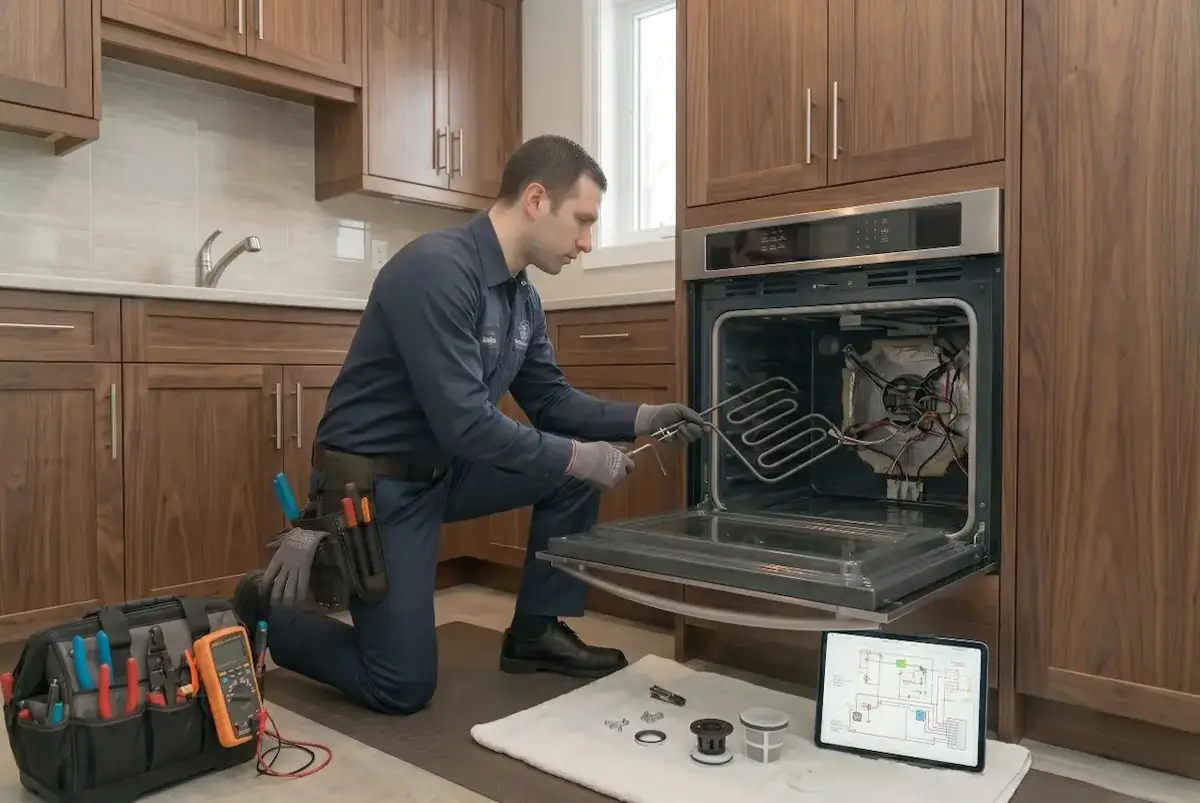
Why is my oven not heating at all?
Most common cause on a wall oven in the GTA: electric: failed (open/burned-out) bake element — often visibly blistered or severed. A typical repair runs $319–$489 all-in, including the $149.95 diagnostic, credited 100% toward your repair. No safety risk once you stop using it — book at your convenience, sooner if it's your only cooking appliance. Book at convenience
Prices in CAD for the GTA; typical ranges — your exact quote is confirmed on-site before any work. Updated .
Most wall oven faults in the GTA come down to a handful of parts — and the majority are worth repairing rather than replacing an appliance that typically lasts 13–15 years. Anthony is a Red Seal certified technician who carries the common wall oven parts on the van, so most jobs in the GTA are diagnosed and fixed in a single visit.
Wall Oven repair costs in the GTA
Honest, all-in ranges for common jobs. Every visit starts with a flat $149.95 diagnostic that is credited 100% toward your repair — so you never pay it twice.
| Problem | Parts | Labour | All-in |
|---|---|---|---|
| Oven not heating at all | $30–$190 | $199–$289 | $319–$489 |
| Diagnostic (credited to the repair) | $149.95 |
Ranges are estimates for common jobs in the GTA; your exact quote is confirmed on-site before any work begins. Prices in CAD, updated .
How your repair works
Four simple steps, no surprises.
Book
Call or request a callback. Same-day & next-day appointments available.
Diagnose
A flat $149.95 diagnostic pinpoints the real fault.
Approve
You get an upfront all-in quote first — diagnostic credited 100% toward your repair.
Repaired
Fixed with OEM parts, backed by a 90-day warranty.
Common Wall Oven problems & what we check
Tap any problem for the likely causes, what is safe to check yourself, and what it costs.
Oven not heating at all$319–$489
Oven not heating at all: The oven turns on and the display works, but the cavity stays cold — on an electric oven the bake element never glows orange; on a gas oven you may hear the gas valve but get no flame.
Also described as: oven won't heat, oven cold, stays cold, no heat, oven not getting hot
Likely causes
- Electric: failed (open/burned-out) bake element — often visibly blistered or severed (Most common (electric))
- Gas: weak hot-surface igniter that glows but no longer draws enough current to open the safety gas valve (Most common (gas))
- Failed oven temperature sensor (RTD/thermistor) or a control/relay board not switching power to the element/igniter (Common)
- Blown thermal fuse or tripped breaker cutting power to the heating circuit (Occasional)
How we diagnose it — in order
- Confirm the power supply first, before opening anything. An electric oven runs on 240V split across two 120V legs, and the display only needs one leg — so a half-tripped double-pole breaker leaves the clock lit while the cavity stays cold. Cycle the dedicated breaker fully off and back on, then confirm both 120V legs are live at the rear terminal block. On a gas oven, confirm the gas supply valve is open and other burners light.
- Look and listen during a bake call. Set the oven to Bake and watch the element directly. On electric, a healthy bake element glows uniformly orange within a couple of minutes; a dead spot, blister, or break that never glows points straight at the element (the single most common no-heat cause). On gas, watch the igniter: if it never glows, suspect the igniter circuit; if it glows but no flame follows, that is the classic weak-igniter signature — go to the amp test.
- Test the bake element for continuity (electric). Pull power, isolate one element lead, and read across the terminals with a meter on Rx1 — a good element shows continuity in the tens-of-ohms range; an open (infinite/OL) reading condemns it. Also probe terminal-to-element-sheath: any continuity to ground means the element has shorted and must be replaced. A failed or grounded element here is the fix — replace it.
- Clamp-test the igniter draw (gas). With the bake circuit live, put a clamp ammeter on the igniter wire and watch the draw as it heats. The safety valve only opens once the igniter pulls enough current; a weak igniter that glows but draws below the valve's opening threshold never lets gas through — that is why the cavity stays cold despite a visible glow. Low draw condemns the igniter; replace it (it is the cheaper part and the usual culprit, so rule it out before the valve).
- Verify the thermal protection and limit components. Check the thermal fuse / hi-limit thermostat for continuity — a blown one cuts power to the heat circuit entirely and mimics a dead element or igniter. If open, find the overheat cause before simply replacing it.
- Last, condemn the control. With confirmed 240V (or a proven gas supply), a good element or correctly-drawing igniter, and intact fuses/limits, the failure is the oven control board relay or triac (or the gas safety valve if igniter amperage was confirmed good) — the definitive, most expensive part. Verify the board is switching voltage to the element/valve on a bake command before replacing it.
✔ Safe to check yourself
- Confirm the oven isn't in a delay-start, Sabbath, or demo/showroom mode (check the manual to exit it).
- Check the breaker — a 240V electric oven runs on a double-pole breaker; if one leg trips the broil/bake can lose heat while the display still lights.
- On an electric oven, look through the door while it heats: a healthy bake element glows uniformly orange; dark, blistered, or broken sections confirm a dead element.
✖ Leave to a technician
- Do not test or replace a gas igniter or gas valve yourself — gas work is TSSA-certified-technician-only.
- Do not touch element terminals, the thermal fuse, or board wiring with the oven powered — 240V shock hazard; element swaps mean disconnecting power at the breaker.
Related: Not reaching or holding temperature (uneven baking) · Gas oven won't ignite (igniter glows weakly) · Won't turn on / no display
Ready to get it fixed?
Call now — (647) 490-7878 90-day warranty · flat $149.95 diagnostic credited 100% toward your repairWall Oven oven not heating at all by brand
Brand-specific patterns we see
- Whirlpool: Whirlpool wall ovens (WOS/WOD) and range cavities speak the F#E# code pairs of the range line, and their most teachable failure is thermal: a one-shot thermal cut-off or wall-oven thermal fuse that blows after self-clean and leaves the oven dead. AquaLift-era models trade that pyrolytic risk for weaker steam cleaning. WPW-/W10-/W11-prefix parts are the widest-stocked oven stock in the GTA, so honest per-cavity diagnosis (not a board-cannon) is what protects a four-figure column.
- Samsung: Samsung wall ovens (NV51/NV66 single & double, NQ70 microwave-combo) and the oven cavity inside NX58/NX60 ranges all speak the same C-code electronics dialect as the sibling samsung|stove module: C-21/C-22 temperature-sensor faults, C-d1 door-lock-motor faults on self-clean models, C-d0 stuck key, and C-F0/C-F1 control-board communication/EEPROM errors. Parts ride the DG-prefix channel — widely stocked and orderable — so the routine no-heat and sensor work is economical; the discipline that pays off is separating a dead element from a drifted RTD before quoting the control board.
- Maytag: Whirlpool wall ovens (WOS/WOD) and range cavities speak the F#E# code pairs of the range line, and their most teachable failure is thermal: a one-shot thermal cut-off or wall-oven thermal fuse that blows after self-clean and leaves the oven dead. AquaLift-era models trade that pyrolytic risk for weaker steam cleaning. WPW-/W10-/W11-prefix parts are the widest-stocked oven stock in the GTA, so honest per-cavity diagnosis (not a board-cannon) is what protects a four-figure column.
- Frigidaire: Frigidaire ranges and wall ovens are Electrolux NA platform (parent since 1986), sharing 316-prefix cooking parts with Electrolux-brand and Electrolux-built Kenmore 790 cooking units. They speak the Electrolux F-code dialect (F10/F11/F30/F31/F90), and their defining failure is the electronic oven control (EOC): a no-heat or false-overheat Frigidaire is the EOC or the RTD sensor far more often than the element. We meter the RTD and the element legs before condemning a board, because a drifted sensor and a welded EOC relay read very differently and only one is a fire concern. Parts channel is open — 316-prefix elements, sensors and lock motors are shelf-stocked, EOCs sometimes dealer-ordered or repairable.
- Bosch: Bosch wall ovens (500/800/Benchmark) are BSH-platform columns that fit the 24"-to-30" European-format kitchens common in newer Toronto builds, and they share part-numbering and E-code electronics with their Thermador siblings. Service profile: open bake elements (00-prefix, often no visible burn), heavy multi-pane door systems whose hinge/glass hardware drops or rattles, an NTC thermistor (not an RTD coil) feeding the temperature loop, and module-level electronics where the relay board and the display/control board are diagnosed as a pair before either is condemned. Genuine side-opening (side-swing) doors on premium Benchmark models are a platform-familiar, two-tech handling job.
- Wolf: Wolf E/M-series wall ovens are the premium electric benchmark, and honest service notes exist: older E-series interiors developed the well-known blue-porcelain chipping complaint (handled case-by-case by the manufacturer — worth knowing before anyone panics), while working faults centre on the concealed bake element that opens with no visible burn, heavy-door hinge wear, the RTD temperature sensor, and the power relay/DLB board — all sourced through Sub-Zero/Wolf authorized distribution, with gas + weight + cost-of-error meaning we specialize or decline.
- Viking: Viking wall ovens are Pro-style cooking columns (Greenwood, MS; Middleby-owned since 2013, with legacy QC improved post-2013) whose modern electric cavities run an EOC4 control with an RTD sensor and a numeric F01-F08 fault dialect documented in Viking service literature; service concentrates on hidden bake-element burnout, self-clean-aftermath door-latch faults, RTD drift, and dealer/distributor-channel boards where diagnosis discipline protects a four-figure appliance. Pre-Middleby (pre-2013) units and patchy legacy parts deserve candour and a confirm-by-model/serial before booking.
Brand-specific wall oven repair
Get your wall oven fixed — oven not heating at all repair near you
We diagnose and repair wall oven oven not heating at all across the GTA, same-day where possible, with the flat $149.95 diagnostic credited 100% toward your repair.
Why homeowners across the GTA call us
Every repair is led by Anthony, a Red Seal interprovincial journeyman who is 313A Licensed, TSSA Certified, ODP Certified, with his team working under his direct leadership — backed by $2,000,000+ general liability insurance and a 90-day workmanship warranty on every job.
Red Seal-led team
Every job is overseen by Anthony, a certified journeyman, and handled by his own trusted team.
Licensed & gas-certified
313A refrigeration licence and TSSA gas certification for safe, code-correct repairs.
$2,000,000+ insured
Fully insured for general liability, so your home is protected during the repair.
90-day warranty
Parts and workmanship are warrantied — if it's not right, we come back.
OEM parts on the van
Common parts are stocked, so most jobs are completed on the first visit.
Upfront pricing
A flat $149.95 diagnostic, credited 100% toward your repair, and a quote before any work.
What our credentials mean for you
- Red Seal Certified
- The interprovincial standard for skilled trades — a journeyman who passed the national appliance-service exam.
- 313A Licensed
- Ontario's refrigeration & air-conditioning systems mechanic licence — legally required to work on sealed cooling systems.
- TSSA Certified
- Technical Standards & Safety Authority gas certification — qualified to work safely on gas appliances.
- ODP Certified
- Ozone Depletion Prevention certification — licensed to handle refrigerants responsibly and to code.
Repair or replace your wall oven?
A simple rule of thumb: if the repair costs more than half the price of a comparable new unit and the appliance is near the end of its life, replacement may make more sense.
A wall oven typically lasts – and costs $1,500–$3,500 to replace — so most repairs that come in under about half the replacement cost are worth doing. We'll always tell you honestly when a repair isn't worth your money.
Keep your wall oven running
Simple habits that prevent the most common the GTA repairs.
- Skip the high-heat self-clean cycle where you can — its extreme heat is the leading cause of blown thermal fuses, premature igniter and element failure, and stressed control boards; wipe spills by hand or use a low/steam-clean mode instead.
- Wipe up spills and grease once the oven cools, before they carbonize onto the bake/broil element and door seal.
- Verify the real temperature once a year with a standalone oven thermometer so you catch sensor drift early.
- Check the door gasket seals fully and replace it as soon as it hardens or tears, so the oven holds heat and bakes evenly.
- On a gas oven, note any creeping increase in igniter glow time before light — a slow start is the early warning of a weak igniter.
- Keep the oven on its own dedicated circuit with tight connections; have a wall oven's hardwired connection checked if you ever lose heat on one element.
More appliance repair in the GTA
Nearby cities
Frequently asked questions
Why is my oven not heating at all?
Do you charge for the diagnostic?
How soon can you come out?
Are you licensed and insured?
Do you use genuine parts?
Need your wall oven fixed in the GTA?
Same-day & next-day appointments available. Flat $149.95 diagnostic, credited 100% toward your repair, and a 90-day warranty on every repair.
Call (647) 490-7878